
Mysore, the heritage city of Karnataka is famous for its splendid palaces, sandalwood, and silk, but what really makes this place stand out is the Mysore Palace, its beauty and splendour. Also known as the Amba Vilas Palace, this architectural masterpiece is the official residence of the Wadiyar dynasty, (Wodeyars) who ruled the Kingdom of Mysore for over five centuries. The palace’s grand design, rich history, and dazzling illumination attracts millions of tourists every year, making it one of the most visited heritage monuments in South India.
Table of Contents
Where Is Mysore Palace Located
Mysore Palace is located in the city of Mysuru (formerly known as Mysore) in Karnataka which is approximately 145 km from Bengaluru. The palace is located very close to other major attractions such as Chamundi Hill and St. Philomena’s Cathedral.
Nearest Transport Hubs:
- Mysuru Railway Station – 2km
- Mysuru Bus Stand – 1.5km
- Kempegowda International Airport, Bengaluru – 170km
History Of Mysore Palace

The history of Mysore Palace is an interesting one with over five centuries old stories that tell tales of India’s complex and intriguing past. The old fort or puragiri (citadel), as it was known earlier, faces eastwards towards Chamundi Temple. The old fort’s first palace was constructed by Yaduraya, the founder of the Wadiyar dynasty in the 14th century. Since then, the palace has been demolished and reconstructed several times over the centuries. The construction of this old fort was completed in CE 1574 by Chamaraja Wadiyar IV, Mysore’s seventh king. But the palace was struck by lightning and destroyed.
Ranadheera Kanthirava Narasaraja Wadiyar, the twelfth king of the Wodeyar dynasty, rebuilt the palace in 1638. However, the problems didn’t stop here, the palace once again suffered during the rule of Tipu Sultan. Parts of the complex was demolished in 1797 to make way for his new capital, Nazarbad. After Tipu Sultan’s defeat in 1799, the Wadiyars were reinstated, and Krishnaraja Wadiyar III resurrected the palace from ruins.
Also read: The fascinating history of the royals of the imperial city of Mysore, the Wadiyar’s
Construction Of The Present Mysore Palace
The palace’s most devastating blow came in 1897, when a massive fire broke out during the wedding celebrations of Princess Jayalakshammani. The old palace, also called the Wooden Palace caught fire and burned down to ashes. The current structure that we know as the Mysore Palace was constructed between 1897 and 1912 under the patronage of Queen Regent Kempananjammanni Vani Vilasa Sannidhana and Maharaja Krishnaraja Wadiyar IV.
– British architect Henry Irwin designed the palace after studying architectural styles in Delhi, Calcutta and Madras.
– P. Raghavulu Naidu, an executive engineer of the Mysore Palace division was the supervisor of the project.
– Construction costed approximately ₹42 lakhs—equivalent to nearly $30 million.
– In 1940 it was further expanded under the reign of Maharaja Jayachamarajendra Wadiyar.
Architectural Highlights
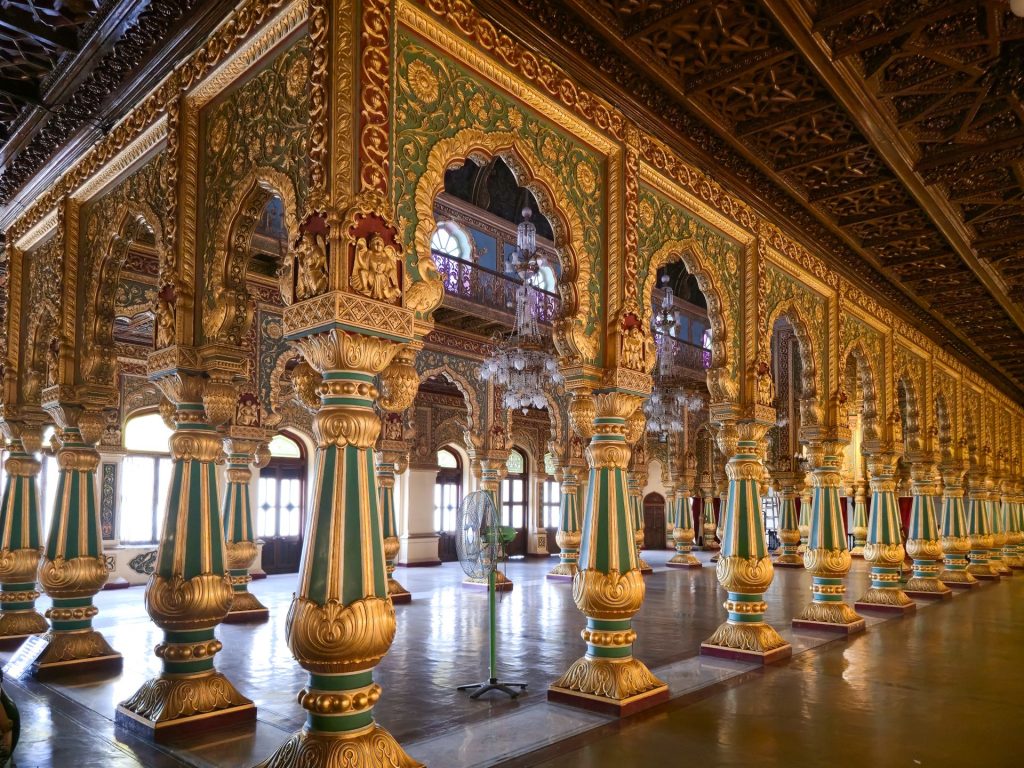
– Three-story stone structure was built using stone and marble in the Indo-Saracenic style.
– Due to its numerous renovations, the palace has a blend of Hindu, Mughal, Rajput, and Gothic styles.
– It has dark pink domes, turrets, expansive arches and colonnades, and a large geometrically laid-out garden.
– A five-story tower that is 145 feet high with a gold-plated dome.
– There are two durbar halls, courtyards, embellished mahogany gates, and the royal family’s living quarters.
– There are 12 temples constructed during various periods by the Wadiyar kings.
– The palace has four main entrances: East gate (Jaya Maarthaanda), West gate (Varaha), South gate (Balarama), and the North gate (Jayarama).
– Mysore kingdom’s emblem and coat of arms are inscribed on the entrance gate and arch.
– The palace cellar is rumoured to have several secret tunnels, which lead to different palaces.
– Exquisite sculpture of the goddess Gajalakshmi and her elephants atop the central arch.
Inside Mysore Palace
As impressive as the structure and exteriors of the palace are, the interior is even more breathtaking. Here are a few key things to look out for:
– Jewel-encrusted, golden throne of the Mysore Royals, which originally belonged to the Vijayanagar kings.
– Vast Durbar Hall, the beautiful peacock-themed Kalyana mantapa (marriage pavilion), the doll’s pavilion, and the museum.
– Ornately carved ceiling and beautifully sculpted and carved blue and gold pillars of the Durbar Hall.
– Floral mandalas, the beautiful paintings of the Dasara procession, and the stained-glass windows.
– Painting of Dasara procession is painted in a way that it seems to move towards the viewers, wherever they stand.
– Museum houses solid silver doors, the sword of Tipu Sultan, several paintings by Raja Ravi Varma, weapons, and cannons.
– On display are several chandeliers, imported from Czechoslovakia.
– Wooden elephant howdah decorated with 84 kgs of gold and the Chinnada Simhasana (golden throne) are top attractions.
Also Read: Seven gorgeous palaces in Mysore that make it the City of Palaces
Mysore Palace And Dasara Festival
The Royals of Mysore and their people have a long tradition of celebrating Dasara festival with great pomp and grandeur. The annual Dasara celebration, also known as the Nada Habba (festival of the state) is when the palace comes alive and is one of the best times to visit the city and see it in all its glory. The festivities observed for ten days include a special durbar (royal assembly). During the durbar, the reigning king grants an audience to members of the royal family, special invitees, officials, and the masses. The sight of the palace illuminated by over 100,000 light bulbs during Dasara is the highlight of the festival.
Light And Sound Show In Mysore Palace
The Sound and Light Show (Son et Lumiere) at the Mysore Palace tells the historical account of the six-hundred-year Wadiyar dynasty. This spectacular dramatic rendition in male, and female voices along with song and music, narrates the grand history of Mysore Palace and its rulers set against the larger perspective of regional historical events. Previously the show used to be only in Kannada, but since January 2018, it is been played in English as well. After the light and sound show, the palace is briefly illuminated.
Nearby Attractions To Explore
Popular places to visit near the palace include:
- Mysore Zoo
- Devaraja Market
- Brindavan Garden
- Sri Chamundeshwari Temple
- Somnathpur Temple
- Venugopala Swamy Temple
- St. Philomena’s Cathedral
Entry Fee And Timings
Visiting Hours: 10:00am – 5:30pm (daily)
Illumination: 7:00pm to 8:00pm (every Sunday and public holidays)
Entry fees:
- Indian citizens: ₹70
- Foreign tourists: ₹200
- Children below 10 years: Free
Tips: For an enhanced visitor experience opt for guided tours that are available in multiple languages.
Also Read: 20 wonderful places to visit when in Mysore
Final Words
The history of Mysore Palace has been an eventful and interesting one. The palace has stood the test of time and still stands tall today. Every wall and pillar here has a story to tell. As responsible travelers, it is on us to preserve this magnificent monument for future generations to enjoy.
FAQs
As Mysore Palace is centrally located, it is easily accessible by road, rail, and public transport. It is just 2 km from Mysuru Railway Station and well connected to Bengaluru by highway.
The best time to visit Mysore Palace is between July and February, when the weather is pleasant for sightseeing. October is especially popular due to the grand Mysuru Dasara celebrations, when the palace is lavishly decorated and illuminated.
Visit the Mysore Palace, climb the stairs of Chamundi Hill, explore Devraja Market, visit the rail museum, and see why the Gokulam’s Yoga schools are known all over the world.
Yes, visitors can enter the palace daily, but taking photos are prohibited inside the main palace building, however it is allowed in the surrounding courtyard.
Yes, Mysore Palace is absolutely worth visiting as it is one of India’s finest royal palaces, offering a unique combination of history, architecture, cultural traditions, and visual splendour. The palace interiors, Dasara celebrations, and night illumination make it a standout attraction in Karnataka.